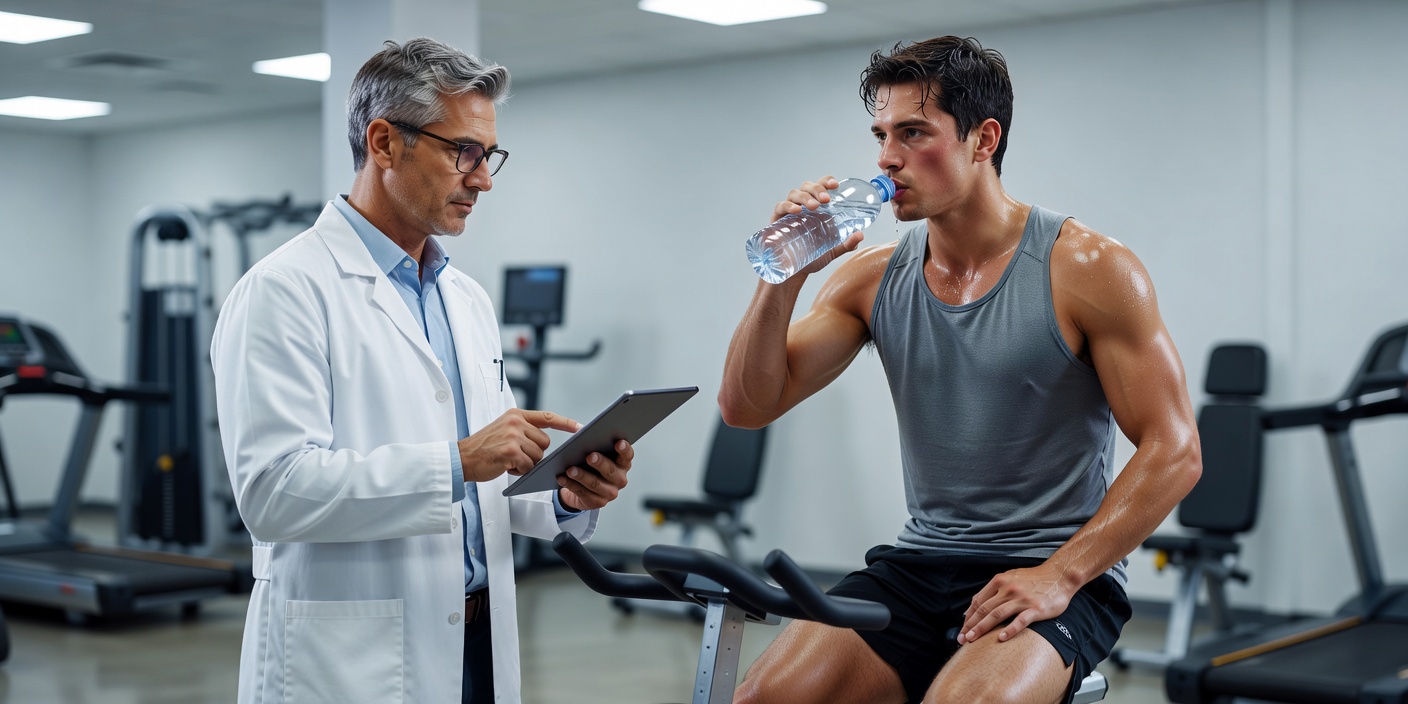
Fluid questions arise in hot races, long training sessions, indoor competition and everyday preparation. Research facilities investigate how exercise, environment, drinking opportunities and individual characteristics interact. Their task is not simply to label a person “hydrated” or “dehydrated.” They need to define the question, choose measures that fit it and avoid treating a laboratory value as a complete picture of performance or health.
Several measures, different jobs
Body-mass change before and after exercise is a common field and laboratory measure. It can help estimate net fluid change over a session, especially when researchers account for fluid consumed, urine produced, clothing and measurement conditions. It is not a direct measure of every fluid compartment, and short-term body-mass shifts do not capture the whole physiology of hydration. A reliable protocol weighs participants consistently and reports the assumptions behind calculations.
Sweat rate is often estimated by comparing body mass before and after exercise and considering intake and urine. The estimate belongs to that session, clothing, climate and workload. A test in a warm chamber may not represent an outdoor event with changing wind, shade, pace and access to drinks. Sweat composition can be measured from collected sweat, but patch sites, contamination, collection duration and local-versus-whole-body differences complicate generalization. One patch is not a personal map of every part of an athlete’s body.
Researchers may also measure urine concentration, blood markers, thirst ratings, core temperature, heart rate or perceived exertion. Each tells a different story and has its own timing and limitations. A single marker cannot automatically stand in for fluid balance, thermoregulation, well-being and performance simultaneously. Methods sections should explain when samples were taken and what decision or hypothesis those measurements support.
Why conditions matter
Heat and humidity can influence sweating and thermal strain, while exercise intensity and duration change opportunities for drinking. Clothing, acclimation, recent training, illness, travel and the timing of meals may also shape a trial. Researchers may use environmental chambers to reproduce a temperature and humidity range more consistently, but a chamber cannot recreate every feature of a race course or competition schedule. Field studies offer realism and less control; controlled trials offer isolation and repeatability. They are complementary rather than interchangeable.
Study designs can include a prescribed intake condition, access to fluids as desired, or comparison of beverages with different compositions. The design must match the ethical and practical question. Investigators explain risks, monitor participants and obtain appropriate ethics review. Researchers do not need to induce dangerous dehydration to ask useful questions. The protocol should include clear stop criteria and trained supervision.
Reading a hydration claim
If a headline says a product “improves hydration,” ask what the authors mean by hydration and which outcome changed. Was the endpoint body-mass change, a blood measure, thirst, temperature, performance, or a composite? Did participants complete a real exercise task, or was the study focused on a short physiological response? Does the comparison account for total fluid and the setting in which the product was used? A measured difference may be statistically detectable without being important to a particular event.
Look at participant characteristics and the conditions tested. An experiment with trained adults exercising in a controlled heat chamber cannot automatically answer a question about a youth tournament, a cold-weather event or a multi-day race. The number of participants, variation between them and uncertainty around the estimate also matter. A useful article states what it cannot conclude and avoids turning one result into a rule for everyone.
From lab to field
Specialist centres such as the University of Connecticut’s Korey Stringer Institute focus on exertional heat illness prevention and safety education. The Australian Institute of Sport publishes practical sports nutrition resources, while the National Athletic Trainers’ Association and World Athletics provide broader resources relevant to athlete health and competition. These organizations do not replace a study’s methods; they help readers locate considered guidance and safety context. Researchers also draw on environmental physiology work at universities including Loughborough and institutions across the United States and Europe.
Field monitoring can capture actual drinking opportunities, clothing, pace and weather, but it creates privacy and measurement challenges. A wearable temperature sensor, GPS trace or intake log may be incomplete. Researchers need to explain who collected data, how missing values were handled and whether the field sample resembles the athletes being discussed. The most realistic study is not necessarily the most precise one, and the most controlled one is not always the most applicable.
Keep the inference proportionate
Hydration studies are useful when they make a specific question testable and describe the conditions clearly. They can help explain how researchers estimate fluid loss, evaluate a beverage or observe responses during exercise. They cannot determine every person’s needs from a single average or a fixed formula detached from the event.
Read the measured outcome, the exercise context, the study group and the safety framework before deciding what a result means. Athletes with medical concerns or questions about individualized fluid planning should seek advice from an appropriately qualified health or sports nutrition professional. The role of this guide is to make evidence easier to inspect, not to provide a personal hydration plan.