Competitive athletes hear claims about “burning more fat,” “saving carbohydrate” or using a particular fuel more efficiently. In exercise physiology, researchers can estimate the mix of fuels contributing to energy production under defined conditions. That estimate helps describe a response. It does not, by itself, prove that an athlete will perform better, feel better or benefit from copying a study protocol.
From breath to estimate
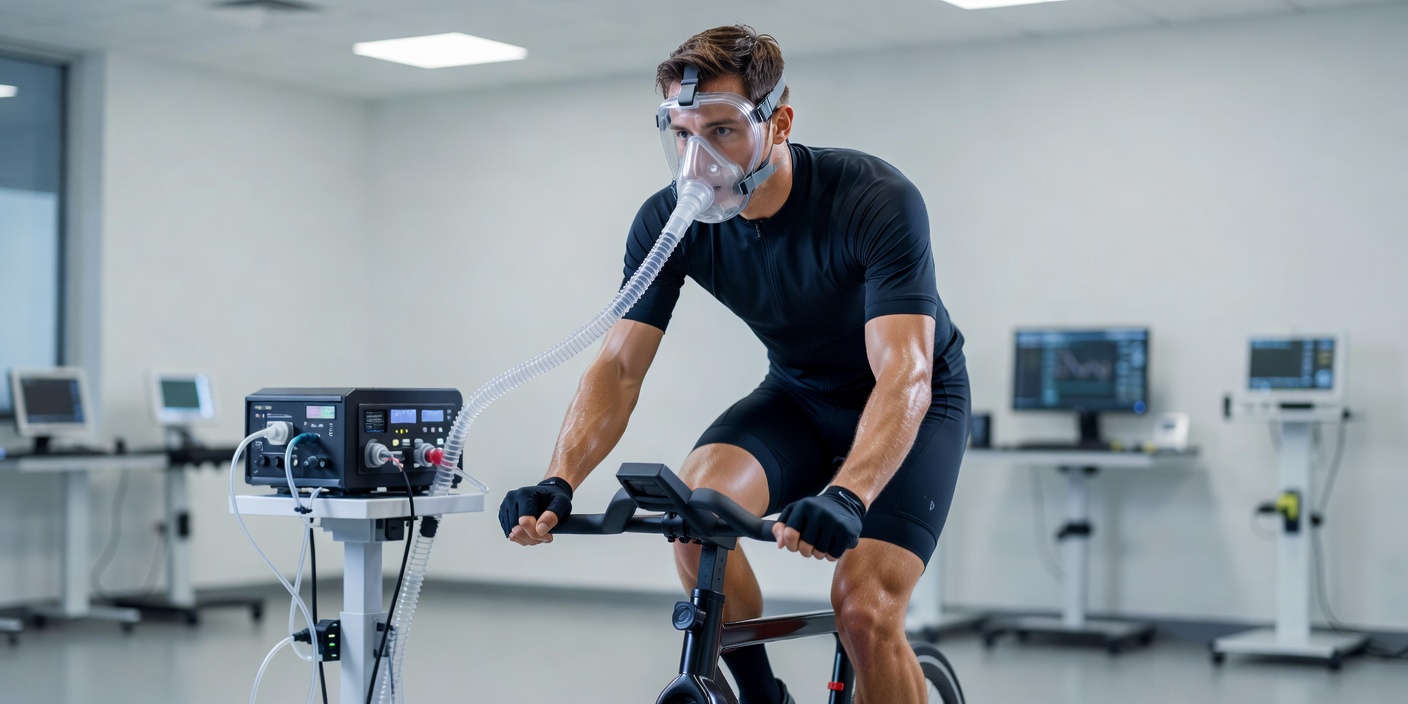
A common laboratory approach measures oxygen consumption and carbon dioxide production, often with indirect calorimetry. The participant breathes through a mouthpiece or mask connected to a gas-analysis system while cycling or running at set workloads. When measurements are steady and key assumptions hold, the exchange of oxygen and carbon dioxide can be used in equations to estimate whole-body rates of carbohydrate and fat oxidation.
The method measures gases, not the contents of a muscle cell. Researchers therefore describe the result as an estimate. Calibration, leaks, breathing patterns, workload transitions and the participant’s ability to reach a steady state can all influence data quality. At very high intensities, acid-base changes and extra carbon dioxide production complicate simple interpretations. Protocol design matters: a short stage at a changing workload may not answer the same question as a sustained, steady bout.
What the lab controls
Researchers may standardize the previous day’s exercise, the timing and composition of meals, sleep instructions, caffeine use and the time of testing. They can set exercise intensity using a measured capacity test, a fixed power output or a percentage of an individual benchmark. These choices affect what the result means. A protocol at one moderate intensity is not a complete description of fuel use across a long race with climbs, surges and tactical changes.
Some studies use isotope tracers to investigate where a substrate comes from or how it is handled. Tracer methods can answer questions that breath measurements alone cannot, but they require specialized sampling and modelling. Muscle biopsies, blood sampling and continuous gas analysis each have distinct burdens and interpretive limits. Research facilities choose measurements based on the hypothesis, feasibility, participant safety and ethics review—not because every available instrument must be used.
Reading a fueling comparison
When a study compares a carbohydrate intake strategy with a control condition, ask whether the overall energy and carbohydrate exposure are understood, whether trials were randomized or counterbalanced, and whether the same athlete completed both conditions. A crossover design can reduce differences between people because each participant acts as their own comparison. It still needs enough time between visits and careful control of familiarization, prior training and carryover effects.
Also distinguish an intermediate outcome from a performance outcome. A higher estimated oxidation rate may show that a fuel was being used under the test conditions. It does not automatically demonstrate a faster time trial, greater power over a race, better tolerance or a durable training benefit. Researchers might measure a time-to-exhaustion test, a fixed-distance time trial, perceived exertion or a biochemical marker. Those endpoints do not mean the same thing, and the most attention-grabbing one may not be the most relevant to athletes.
Why athlete results can differ
Training history, body size, sex, event type, altitude, temperature, gut tolerance, recent diet and competition intensity can all shape responses. A small sample of trained cyclists under laboratory conditions may be valuable for a narrow question, but it cannot represent all runners, team-sport athletes or endurance events. Individual variation is real; so is measurement noise. A reported average response does not guarantee that every participant changed in the same direction.
Facilities such as the University of Bath’s sports and exercise science laboratories, Loughborough University’s performance research settings and the Australian Institute of Sport contribute to a broad field of exercise research. Their work sits alongside methodological standards and reviews from bodies including the American College of Sports Medicine and the International Olympic Committee. Check the original methods and paper rather than assuming that a facility’s reputation makes a finding universal.
A practical reading checklist
- Identify what was measured directly and what was calculated.
- Check workload, trial duration, preparation controls and the study group.
- Separate substrate oxidation from measured performance and practical tolerance.
- Look at uncertainty, individual data and the authors’ stated limitations.
- Ask whether the tested conditions resemble the event you are thinking about.
Fuel-use research can make hidden physiology easier to discuss. Its best contribution is a careful description of what happened in a defined setting and a better next question. For athletes, it is evidence to consider with event demands, health and qualified professional support—not a personal prescription.