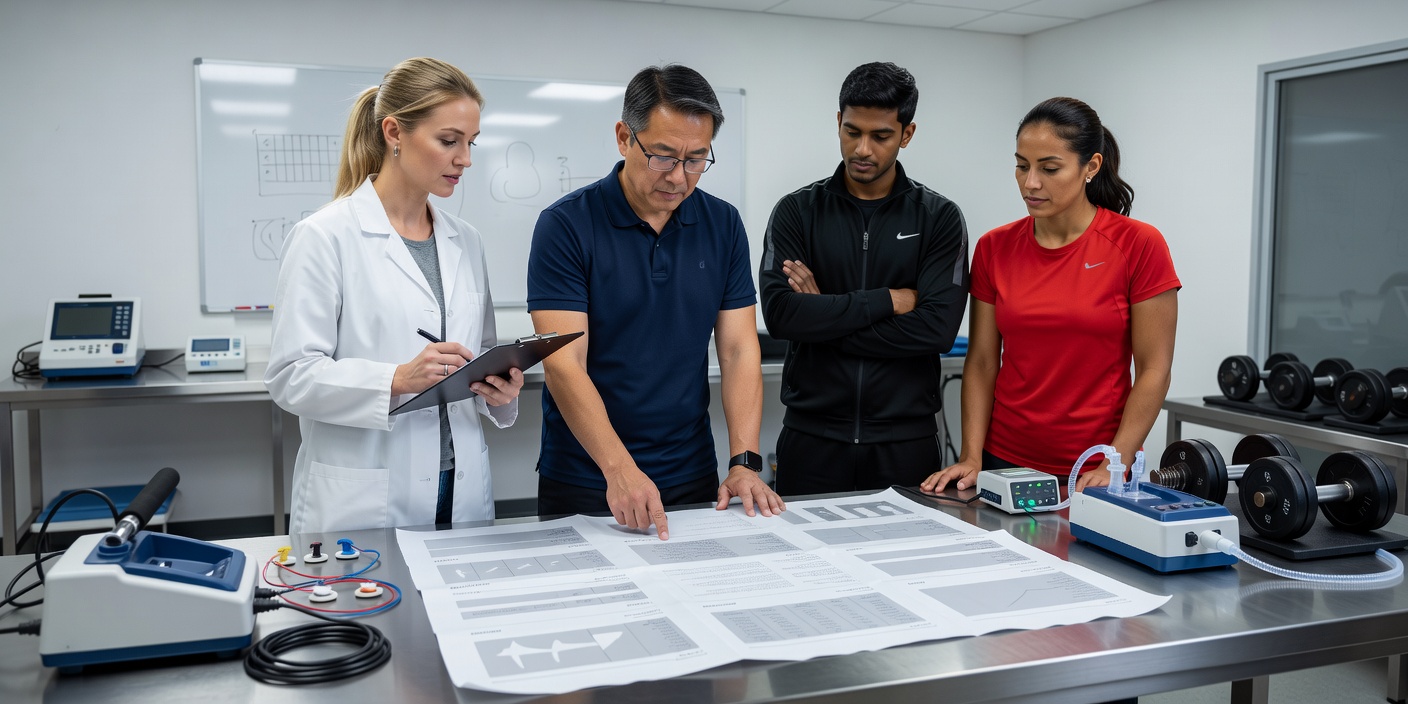
Suppose a team wants to test whether a fueling strategy changes performance. Before recruiting participants or preparing a drink, investigators must turn that broad idea into a question that can be answered. What population? What intervention? Compared with what? Which outcome, and over what period? A precise question helps researchers choose the facility, equipment, timetable and analysis, while making clear what the study will not address.
Define the comparison
A protocol sets out the planned procedures. It may define eligibility criteria, exercise tests, food and fluid standardization, rest intervals, sample collection and rules for stopping a session. Researchers often register a study plan or publish a protocol to make intended methods visible. Registration can help readers distinguish planned outcomes from additional analyses later, but it does not guarantee strong design or flawless execution.
In a randomized trial, chance determines which participants receive which condition first or which group receives an intervention. Randomization can reduce systematic differences between groups. In a crossover design, participants complete more than one condition, often in a counterbalanced order. This allows an individual to act as their own comparison, which may be helpful when people differ substantially. Crossover trials need suitable washout periods and attention to learning, fatigue and carryover effects.
A parallel-group design assigns different participants to different conditions. It avoids some repeated-test effects but may need more participants to account for differences between groups. No design is best for every question. Feasibility, safety, the duration of the intervention, participant burden and the outcome all influence the choice.
Control what matters
Researchers try to control the variables that could obscure the effect they are interested in. For exercise nutrition studies, that might mean recording or standardizing training in the preceding days, meal timing, sleep instructions, caffeine, test time and warm-up. Complete control is rarely possible, and overly strict preparation can make a trial unlike real life. The protocol should justify the controls and document deviations rather than pretending that every participant arrived under identical circumstances.
Blinding can reduce expectation effects, particularly when participants or assessors do not know which condition is being tested. Blinding is easier for some interventions than others. A drink’s taste, texture or packaging may reveal its identity; researchers can use matched products or blinded outcome assessment where feasible. Reports should explain who was blinded and how. A study should not imply that a trial was double-blind if practical limits made that impossible.
Choose outcomes that answer the question
Outcomes might include a performance test, a physiological measurement, a rating of gastrointestinal comfort or a training outcome over time. Researchers should identify a primary outcome in advance and explain why it matters. A laboratory marker can help explain a mechanism, while a performance task addresses a different question. A result in one does not automatically establish a result in the other.
Testing procedures should be familiarized where learning could change the result. A time trial may require practice so that participants understand pacing and equipment. Equipment needs calibration, staff need consistent procedures and the research team should establish how data will be checked. Good methods also consider missing data, protocol deviations and whether the statistical plan matches the design.
Sample size, uncertainty and ethics
A very small study may be useful for feasibility or early exploration, but estimates can be uncertain and unstable. The number of participants should be justified with a transparent rationale, such as a prespecified calculation based on the primary outcome and a meaningful effect. More participants do not automatically fix poor measurement or an unclear question. Readers need the estimate and its uncertainty, not only a statement that a difference did or did not cross a statistical threshold.
Ethics review and informed consent are central to research involving people. Participants should understand procedures, foreseeable burdens, data handling and the right to withdraw. Protocols need appropriate safety monitoring, qualified staff and stopping rules, especially for strenuous exercise, heat exposure or invasive sampling. The Declaration of Helsinki provides widely recognized ethical principles for medical research involving human participants; local regulations and institutional review processes also apply.
From protocol to credible report
Useful reporting describes participant flow, the actual procedures, the intervention and comparison, adherence, adverse events and the analysis. CONSORT guidance helps researchers report randomized trials; the SPIRIT statement supports protocol reporting. These are reporting standards, not magic quality certificates. A checklist can improve completeness, while critical appraisal still asks whether the chosen design could answer the question.
Sports science institutions—including Loughborough University, the University of Bath, the Australian Institute of Sport and the Gatorade Sports Science Institute—publish research, education and resources across the field. Journals and professional societies also shape methodological discussion. The name of a laboratory is less important than transparent methods and a conclusion that stays within the evidence.
A reader’s quick audit
- Was the question specific and the comparison appropriate?
- Were allocation, controls and blinding described honestly?
- Does the chosen outcome match the claim being made?
- Are participant numbers, missing data and uncertainty reported?
- Were ethics, safety and conflicts of interest addressed?
Good study design is a chain of decisions, not a badge attached to a paper. When those decisions are visible, readers can judge what the experiment contributes and what remains unknown. For competitive athletes, this is a useful way to keep an exciting claim in proportion: understand the test before deciding how far its result might travel.